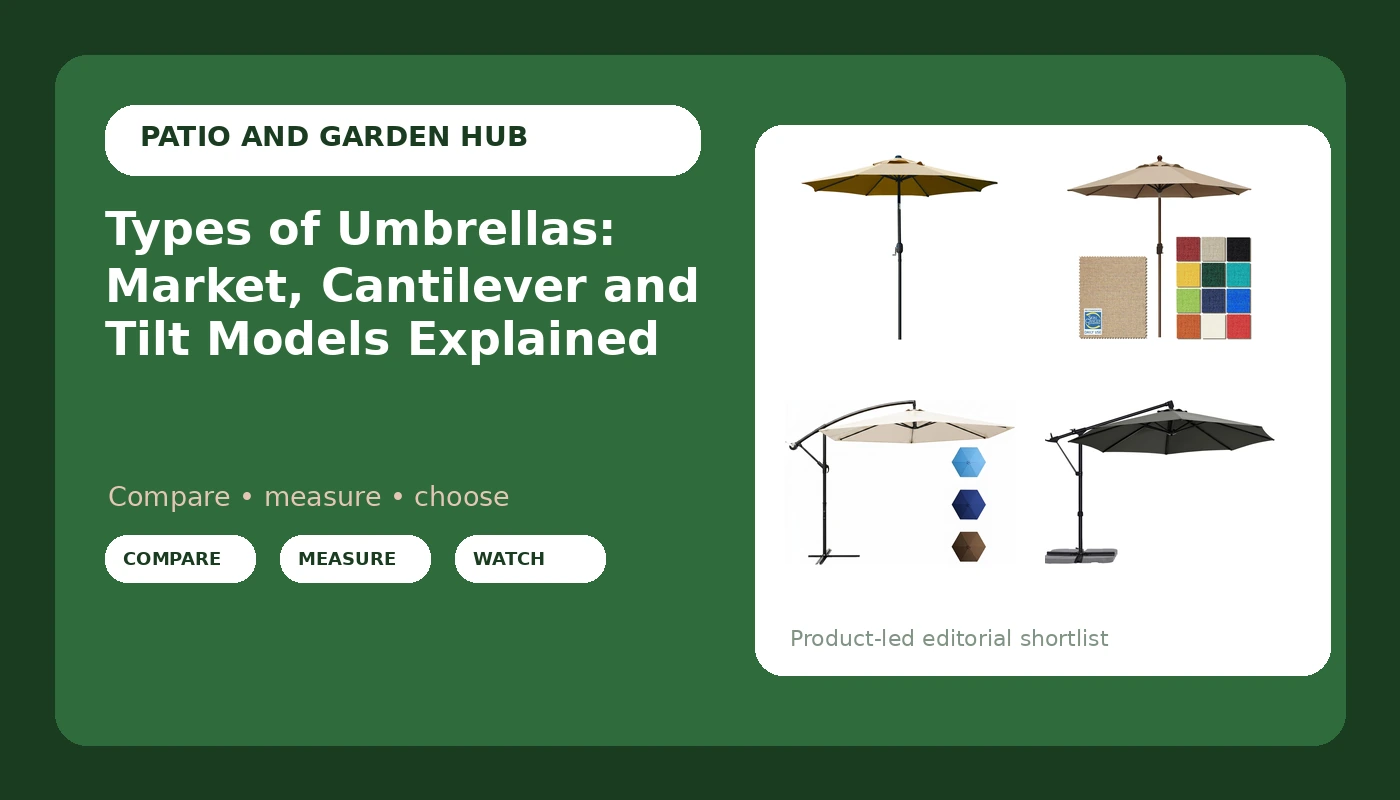
Patio shade looks like a simple purchase until you are standing in a catalog, and that is when the types of umbrellas start to matter. A table umbrella drops through a hole in your dining table, a tilt crank model leans the canopy toward the afternoon sun, and a cantilever offset umbrella hangs its canopy from a side arm so nothing has to sit under the fabric. Each one solves the same problem differently, and the wrong pick shows up as a canopy that fights your furniture or a base that eats the walking space around the grill.
This guide covers the main types of umbrellas sold for patios and gardens, matches four current models to the jobs they suit, and works through the sizing, fabric, and weather resistance questions that decide whether the umbrella still looks presentable in three summers. If you are new to all of this, the short version is that the mounting style matters more than the canopy color.
Quick answer
The types of umbrellas split into two families that actually change how you shop: umbrellas whose pole passes through a table hole and stands on a base or the table itself, and cantilever umbrellas that hang the canopy from an offset arm so the space underneath stays clear. A table umbrella is the simpler, lighter choice for a standard dining set. A cantilever is the better fit when you want shade over loungers, a pool edge, or any spot with no table to anchor it. Within both families, a crank opens the canopy, a tilt angles it, and a vented top lets air pass through instead of pushing the whole thing sideways.
4 useful options
| Model | Best fit | What stands out |
|---|---|---|
| Sunnyglade 9' Patio Umbrella Outdoor Table Umbrella Tilt Crank | Shade over a standard dining table | 9-foot table umbrella with crank and tilt |
| EliteShade USA 10-Year-Non-Fading 9Ft Market Patio Umbrella, UPF 50+ UV Protection Performance Sun Umbrella, Heavy Duty Commercial Grade Outdoor Table Umbrella with Crank & Tilt, Windproof Vented Top for Garden, Pool, Deck and Outdoor Playsets,Heather Beige | Long daily sun exposure | Fabric described as 10-year non-fading, UPF 50+, vented top |
| Greesum 10FT Cantilever Offset Patio Umbrella, Outdoor Umbrella for Yard, Market, Heavy-Duty Waterproof Pool Umbrella with 6 Sturdy Ribs, UV Protection for Beach, Deck, Garden, Backyard (Beige) | Free-standing shade over seating or poolside | 10-foot offset canopy with 6 ribs, waterproof, UV protection |
| ABCCANOPY 10FT Cantilever Offset Hanging Patio Umbrella | Wide offset coverage on a deck or patio | 10-foot hanging canopy on an offset frame |
Table umbrella: Sunnyglade 9' Patio Umbrella Outdoor Table Umbrella Tilt Crank
This is the pattern most people picture when they think about types of umbrellas: one pole, one canopy, a hole in the middle of the table. The appeal is mechanical simplicity. There is no arm to swing, no counterweight to fill, and nothing to trip over on the way to the grill. The table provides the footprint, so a separate weighted base is often only needed if the table is lightweight or the canopy catches a lot of wind.
The trade-offs are worth naming. Because the pole runs down the middle of the table, you lose the center of the surface and one seating position has to work around it. The tilt helps with a low sun but usually tilts in one direction, so it is not a fix for changing sun angles through the day. And a table umbrella is only as stable as the table above it, which is why umbrellas for small patios often work better as a lighter table model than as a big cantilever with a heavy base.
Fade-resistant market umbrella: EliteShade USA 10-Year-Non-Fading 9Ft Market Patio Umbrella
Fabric is where market umbrellas quietly separate from each other. Two canopies can look identical in a photo and behave completely differently after a season of UV, chlorine mist, and sprinkler overspray. The non-fading claim on this model is the whole pitch, and it matters most if the umbrella lives in full sun rather than under a pergola or on a shaded north-facing deck. A UPF 50+ rating is the other number to read closely, since it describes how much UV the fabric blocks rather than how cool the shade feels.
The vented top is not decoration. Wind that would otherwise fill the canopy like a sail escapes through the opening, which reduces the load on the pole and the tilt joint. It does not make an umbrella storm-proof, and no vented canopy should be left open in a gusty front. The crank and tilt hardware is the part to check in umbrellas reviews, because mechanism quality, not color, is what usually ends an umbrella's useful life. For a dining set that gets daily sun, this is the version of the table umbrella that is built around longevity rather than price.
Offset cantilever: Greesum 10FT Cantilever Offset Patio Umbrella
Cantilever umbrellas are the answer to a specific frustration: you want shade over a lounger, a pool ladder, or a seating group with no table, and a center pole would be in the way. The frame carries the canopy out on an arm, so the space underneath is completely usable. That is also why this type demands more from the base. The arm acts as a lever, and a cantilever that is not properly weighed down is the most common way people end up chasing a canopy across the yard.
The 10-foot span here is generous, which is both the point and the caution. A wider canopy shades more furniture and catches more wind. Before buying, measure the swing of the arm as well as the canopy, because the frame has to travel through the space beside it when you open and rotate it. Umbrellas weather resistance starts with the frame and base on this type, not the fabric. The 6-rib build and waterproof canopy are sensible for poolside use, but the umbrella still needs to be closed when weather turns.
Hanging cantilever: ABCCANOPY 10FT Cantilever Offset Hanging Patio Umbrella
Hanging and straight cantilevers do the same job with slightly different geometry. A hanging canopy is suspended from the arm above it, which can give a cleaner line of sight under the fabric and makes the umbrella feel less like it is leaning into the seating area. The practical difference for most buyers is the footprint: the arm and the base both occupy floor space, so the umbrella needs a corner or an edge, not the middle of a walkway.
Two of the four options here are cantilevers, and that is a fair reflection of the market. Most shoppers comparing top rated umbrellas are really deciding between a table model and an offset model, then picking a size. Neither cantilever is a substitute for a table umbrella on a windy, exposed patio, and neither should be judged by canopy color alone. Weigh the base, check the arm's rotation clearance, and confirm the canopy height clears the tallest person who will stand under it.
Prices and availability may change. Product images, names, and retailer links must be matched by verified ASIN. Do not state a current price, rating, stock status, or measured result without current evidence.
How the main types of umbrellas differ
The types of umbrellas sold for outdoor living separate along three lines: how they mount, how they open, and what the canopy fabric is asked to survive.
Mounting is the biggest fork. Table umbrellas, sometimes called market umbrellas, use a pole that passes through a hole in the tabletop and rests on a base beneath it. They are stable, inexpensive to produce, and easy to store, but they commit you to a table. Free-standing cantilever umbrellas move the pole to the side and hang the canopy from an arm, which frees the space underneath at the cost of a heavier base and more mechanical parts.
Opening mechanisms come next. A crank winds the canopy up and down the pole, a push-up model simply slides, and a tilt feature angles the canopy toward a low sun. Tilt is genuinely useful in the late afternoon and close to useless if the sun moves across the whole day, so treat it as a convenience rather than a solution.
Fabric and venting decide comfort. A vented top lets wind escape, which reduces lift, and a UPF rating describes UV blockage rather than temperature. Solution-dyed fabrics generally hold color better than surface-dyed ones, which is why non-fading claims are worth reading closely.
Finally, there are the portable and compact umbrellas you see at the beach or on a balcony. They belong to the same family but are not patio furniture, and they should not be asked to shade a dining set.
Umbrellas size guide and weather resistance
This umbrellas size guide comes down to two measurements and one habit. The first measurement is your table or seating group: a 9-foot canopy is the common pairing for a standard four- to six-seat dining table, while a 10-foot canopy suits larger sets or a lounger group. The second is clearance, meaning the height from the ground to the lowest edge of the canopy, which needs to clear heads and sightlines. The habit is closing the umbrella whenever you leave the yard, because most damage happens on a windy afternoon when nobody is outside.
Weather resistance is a chain rather than a single feature. The fabric resists UV and water, the vent reduces lift, the frame ribs spread the load, and the base holds everything down. A weak link anywhere ends the umbrella's season early. That is why a cheap canopy on a good frame outperforms a premium canopy on a light one.
- Measure the table or seating group and add a little overhang on each side.
- Measure the space the base and arm will occupy, not just the canopy.
- Note wind exposure: open lawn and pool decks punish cantilevers more than a sheltered corner does.
- Read the fabric claim, UPF rating, and vent design before the color.
- Budget for the base. It is part of the umbrella, not an accessory.
For umbrellas for beginners, the fifth step is the one that gets skipped, and it is the one that decides whether the umbrella stays upright. This is also the part of any umbrellas buying guide that pays for itself fastest: a properly weighted base costs less than replacing a bent frame.
Practical guidance for a long-lived umbrella
- Store the canopy closed and, if the model allows, remove the fabric for winter.
- Rinse salt and chlorine off the fabric before storing, since both shorten fabric life.
- Clean the crank and tilt joints lightly and check the locking pin each season.
- Use a base rated for the canopy size, and add weight rather than trusting a hollow base.
- Skip the open position during storms, and never leave a cantilever open overnight.
Two smaller notes help more than they sound. Set a cantilever so the arm sits over lawn or gravel rather than a walkway, and check the sun path once before you commit to a spot. Moving a fully loaded base is a job you only want to do once.
Which option should you choose?
Choose the Sunnyglade 9' Patio Umbrella Outdoor Table Umbrella Tilt Crank when you have a normal dining table, want a lightweight umbrella with a crank and tilt, and do not want a base taking up floor space. Choose the EliteShade USA 10-Year-Non-Fading 9Ft Market Patio Umbrella, UPF 50+ UV Protection Performance Sun Umbrella, Heavy Duty Commercial Grade Outdoor Table Umbrella with Crank & Tilt, Windproof Vented Top for Garden, Pool, Deck and Outdoor Playsets,Heather Beige when the table sits in full sun all day and the fabric claim is the part you care about most. Choose the Greesum 10FT Cantilever Offset Patio Umbrella, Outdoor Umbrella for Yard, Market, Heavy-Duty Waterproof Pool Umbrella with 6 Sturdy Ribs, UV Protection for Beach, Deck, Garden, Backyard (Beige) when you need shade over loungers or a pool edge and can supply a properly weighted base. Choose the ABCCANOPY 10FT Cantilever Offset Hanging Patio Umbrella when you want the same offset coverage with a hanging canopy and have a corner or edge to place the frame.
One caveat applies to all four: the product names describe features, not performance guarantees. Fabric fading, wind behavior, and base stability depend on your site, your base, and how often you close the canopy. Use umbrellas reviews to check the mechanism and base fit, and treat any single write-up, this one included, as a filter rather than a verdict.
The bottom line
The types of umbrellas that matter for a patio are the table umbrella, which anchors through your dining set and keeps things simple, and the cantilever, which trades a heavier base for clear space underneath. Within those two families, the tilt, the crank, the vented top, and the fabric rating are the features worth paying attention to, and the base is not optional. Pick the mounting style that matches your furniture and your wind exposure first, then choose the canopy size, and you will end up with shade that still works after the novelty of a new umbrella wears off.